 Skip-the-line available
 Visiting the Paço dos Duques de Bragança: a complete guide
The palace's history, what to see inside, how long to spend, and how to combine it with Guimarães Castle and the old town in the birthplace of Portugal.
Part medieval manor, part 20th-century reconstruction, the Paço dos Duques de Bragança is the centrepiece of a visit to Guimarães — the city where Portugal was born. This guide walks you through what the palace is, what to look for inside, and how to build a memorable half-day or day around it.
A Burgundian palace unlike any other in Portugal
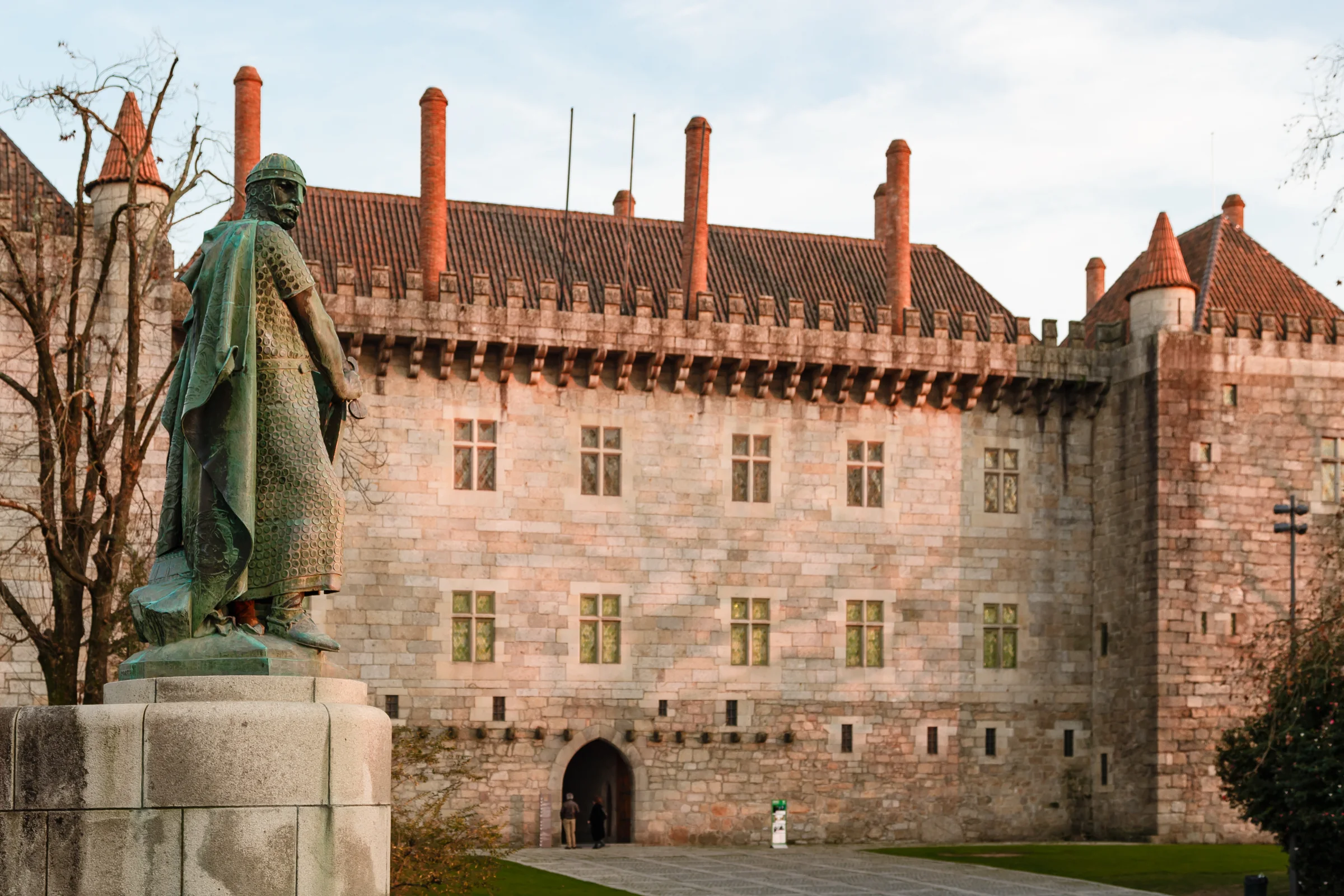
Begun between 1420 and 1422 by Afonso, Count of Barcelos and first Duke of Bragança, the palace was the work of a man who had travelled the courts of France, Venice, Aragon and Castile and came home with northern-European tastes. The result — steep roofs, four ranges around a courtyard, and a forest of tall brick chimneys — looks more like a manor of Burgundy or the Low Countries than anything else in Portuguese architecture.
Its thirty-nine chimneys are the image by which Guimarães is known, and the reason the palace is instantly recognisable in photographs. Much of the plan you walk took shape in a 16th-century phase under the 2nd Duke, Fernando, who pushed it towards a grander, more symmetrical design.
What to see inside
The showpiece is the great banquet hall, roofed with a vast timber ceiling shaped like an inverted ship's hull. Around it, the ducal apartments are hung with tapestries — most famously the Pastrana series depicting Portugal's 1471 conquests of Arzila and Tangier, among the finest Flemish weavings of the 15th century.
Beyond the hall you'll find arms and armour, Portuguese and Chinese porcelain, Flemish and Portuguese painting, heavy carved furniture, and the intimate palace chapel — all arranged to evoke a lived-in noble household rather than a conventional gallery. Give the arcaded courtyard and loggias a slow lap too.
Ruin, reconstruction and why it looks so complete
The Braganças moved their seat to Vila Viçosa in the 16th century and the Guimarães palace was left to decay; by the 19th century townspeople were quarrying it for stone. It was classified a National Monument in 1910, but its dramatic present form owes to a sweeping restoration under the Estado Novo regime from the late 1930s, directed by the architect Rogério de Azevedo.
That reconstruction — which turned the palace into an official residence of the Portuguese Presidency in the north — is genuinely controversial: critics argue it invented a grandeur the building may never have had. It's worth knowing as you visit that much of what reads as medieval is a 20th-century idea of the medieval, now part of the monument's own story.
How long to spend, and the best time to go
Most visitors spend 60 to 90 minutes in the palace. Add the castle and old town and you have a comfortable half-day; add the Alberto Sampaio Museum and you have a full morning. The palace is busiest from late morning to mid-afternoon, and on summer weekends and Portuguese public holidays.
For the quietest visit, take the first morning window or the last of the afternoon. Guimarães also fills for its festivals — the Festas Gualterianas in early August above all — when the old town is at its liveliest.
Guimarães beyond the palace
The palace stands in the UNESCO-listed old town — 'Aqui nasceu Portugal', Portugal was born here, is carved on the city wall. A few steps away are Guimarães Castle, its keep linked to Afonso Henriques, the first King of Portugal, and the little Romanesque church of São Miguel where tradition says he was baptised.
Below the castle hill, the medieval streets around Largo da Oliveira and Praça de São Tiago are among the best preserved in the country, full of cafés and tascas. Don't miss the Alberto Sampaio Museum nearby, and — for a view — the Penha hilltop above the city, reached by cable car.
Getting there and making a day of it
Guimarães is about 50 km north-east of Porto — roughly an hour by Urban or regional train from Porto Campanhã, then a 15-minute walk uphill from the station, or about 45 minutes by car on the A3/A7. From Lisbon it's a longer haul (around three and a half hours), so most visitors come as a day trip from Porto or as part of a northern-Portugal circuit with Braga.
A classic day: morning at the palace and castle, lunch on Largo da Oliveira, an afternoon wander through the old town and the Alberto Sampaio Museum, and the Penha cable car for sunset.
Frequently asked
How long should I allow for the Paço dos Duques?
60–90 minutes for the palace itself; half a day if you add the castle and old town, a full morning with the Alberto Sampaio Museum too.
Is it worth visiting Guimarães from Porto?
Very much so — it's an easy hour by train from Porto and one of Portugal's most rewarding day trips, combining the palace, the castle and a beautifully preserved UNESCO old town.
Why does the palace look so intact for a medieval building?
Because it was extensively rebuilt in the mid-20th century after standing as a ruin. That reconstruction is itself part of its history and the reason the medieval shell reads so complete.
What are the Pastrana tapestries?
A celebrated series of 15th-century Flemish tapestries depicting Portugal's conquests of Arzila and Tangier in 1471 — a highlight of the palace's collections.
Is this the Braganza palace from Lisbon?
No — this is the medieval ducal palace in Guimarães, the family's first seat, not to be confused with later Braganza residences such as the great palace at Vila Viçosa.